
How to Spot a Deepfake Video in 2026: A Practical Checklist
By AI Detector 360 Editorial Team · · Updated July 9, 2026 · 7 min read
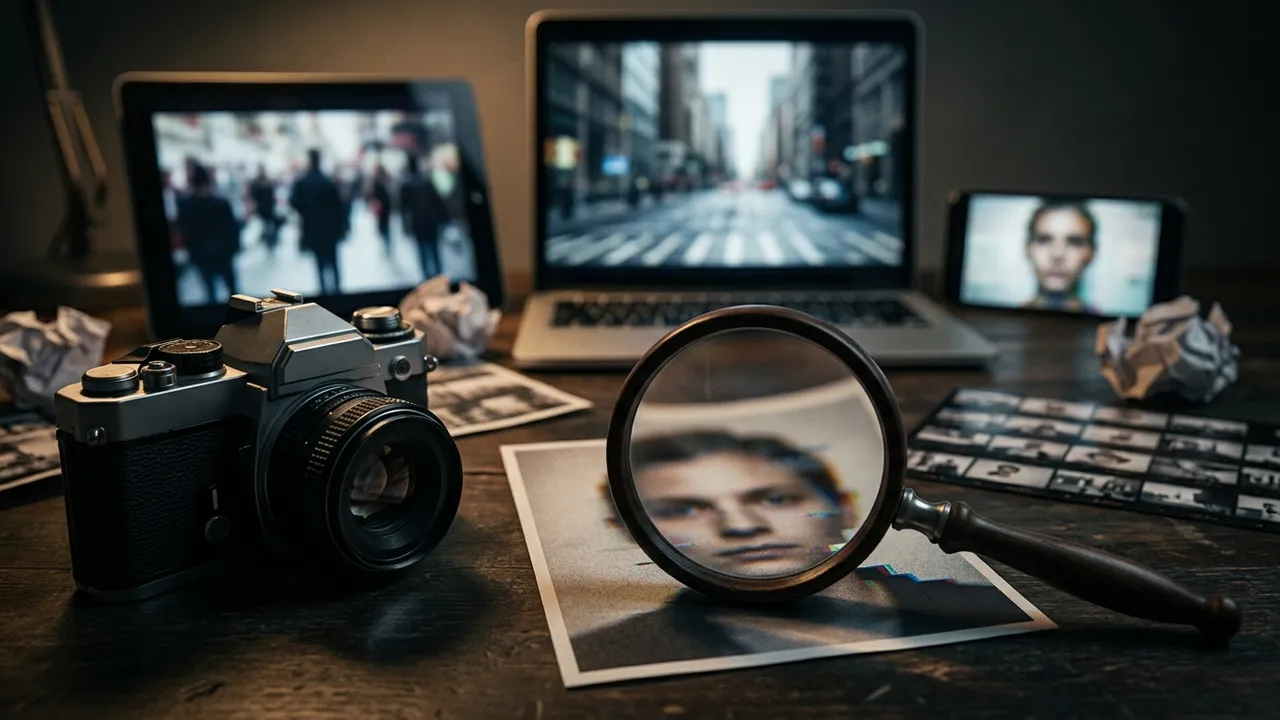
In early 2024, a finance employee at the engineering firm Arup joined a video call with the company's CFO and several colleagues, then wired out HK$200 million (about US$25.6 million) across 15 transfers. Everyone else on that call was a deepfake. The employee had even suspected the initial email was phishing — seeing familiar faces on video is what dissolved the doubt.
To spot a deepfake, slow the footage down and interrogate the face: boundary seams at the hairline and jaw, unnatural blinks, lip-sync drift, and lighting that doesn't match the room. Then check the audio, the source, and — before you act on anything — verify through a second channel. No single tell is definitive anymore; the checklist is what works.
Key takeaways
- In iProov's 2025 study, only 0.1% of 2,000 participants correctly sorted every real and fake sample — while 57% believed they'd spot a deepfake.
- Face boundaries, mouth interiors and face-vs-scene lighting mismatches remain the most productive visual checks.
- Audio has its own tells: missing breaths, flat prosody and absent room tone.
- The strongest defense isn't visual at all — verify identity and requests through an independent channel.
Why your gut needs a checklist
People wildly overestimate themselves on this task. When iProov showed 2,000 UK and US consumers a mix of real and AI-generated images and video in early 2025, just 0.1% correctly classified every sample — two people in two thousand — even though participants knew they were being tested. Meanwhile 57% said they were confident they could spot a deepfake. That gap between confidence and performance is exactly what fraudsters monetize, and the volume is industrial now: Entrust's 2025 Identity Fraud Report logged a deepfake attempt every five minutes during 2024.
A checklist fixes the two failure modes of gut instinct: it slows you down, and it points your attention at the specific places where synthesis still breaks. Those places have moved over the years — this is the 2026 map. (For the broader numbers on fraud and detection rates, see our deepfake statistics roundup.)
How to spot a deepfake: the face-level checks
Face-swap and reenactment deepfakes share one architectural weakness: a generated face has to be composited into real footage, frame after frame. The seams are where to look.
The boundary
Watch the perimeter of the face — hairline, jawline, ears, neckline — especially during fast head turns or when a hand crosses the face. Look for a soft halo or double edge, skin tone that steps at the jaw, earrings that flicker, or wisps of hair that smear like wet paint for a frame or two. Occlusions are the hardest case for swap models, so a hand brushing hair away is a gift: pause and step through it.
The eyes
Blink failure, the famous 2018 tell, is mostly fixed. What remains is subtler: eyes that look glassy or slightly "locked" while the head moves, corneal reflections that don't match each other or the room's actual light sources, and eyelids that lose their crease mid-blink. Step through a blink at quarter speed; real lids deform and cast tiny shadows, synthetic ones often just interpolate.
The mouth
Lip-sync models put their error budget inside the mouth. Common artifacts: teeth rendered as a continuous white strip without individual edges, a tongue that stays suspiciously still through speech, and audio that runs a beat ahead of or behind the lips — most visible on plosives like p and b, where lips must fully close. If the speaker's mouth is doing generic open-close motion while the audio carries crisp consonants, be suspicious.
The light on the face
A swapped face inherits lighting baked in from its source data. Compare it to the scene: window light from the left should warm the left cheek and shadow the right; a face that stays evenly lit while the person walks past a lamp is composited. This is the same physics check that exposes still images — our guide on telling whether an image is AI-generated covers it for photos, and it transfers directly to paused video frames.
| Check | Look for | Caveat |
|---|---|---|
| Face boundary | Seams, halos, smearing hair at jaw and hairline | Cleanest in high-quality fakes; check during motion |
| Eyes | Mismatched reflections, glassy stare, crease-less blinks | Needs slowed playback |
| Mouth | Fused teeth, static tongue, sync drift on plosives | Compression can mimic minor sync issues |
| Lighting | Face lit differently than the scene | Professional lighting can look "too even" legitimately |
| Audio | No breaths, flat prosody, missing room tone | Studio recordings are naturally clean |
Listen before you look again
Audio deepfakes ride along with most video fakes, and they have independent tells. Do one pass with your eyes closed. Cloned voices tend to be too clean: no audible breaths between phrases, no mouth clicks, no room reverb that matches the visible space. Prosody is the other giveaway — emotional flatness, evenly spaced words, stress landing on odd syllables, and a total absence of the false starts and mid-sentence corrections that riddle real speech.
None of this is conclusive alone. A podcast studio produces clean audio legitimately. But a "CEO" calling from a car with zero road noise and studio-grade diction? That mismatch between claimed context and acoustic reality is the tell.
Sync is the intersection check. Fake audio and fake video are usually generated separately and married afterward, so watch for drift that comes and goes — perfect alignment in one sentence, a two-frame lag in the next. Genuine recordings don't oscillate like that; an encoding problem delays audio consistently, not intermittently.
Scan videos for AI, frame by frame
Our video detector samples frames across the timeline and shows you exactly where AI signals spike.
Try the AI video detectorContext beats pixels
Arup's employee lost the pixel game but could have won the context game with one phone call. Build these habits for any video that asks something of you — money, credentials, outrage, a share:
- Trace the source. Where did this clip first appear? An official account, or a three-day-old account with eleven followers? Reverse-search a few key frames to find earlier versions; recycled or re-captioned footage outnumbers true deepfakes.
- Check for provenance signals. Some AI video now ships with C2PA Content Credentials and visible watermarks, and platforms increasingly label synthetic media. AI Detector 360 reports surface these provenance signals alongside the pixel analysis, but the caveat stands everywhere: labels help when present, and they're routinely stripped by re-encoding, so absence means nothing.
- Verify out-of-band. For anything involving money or access: hang up, call back on a number you already have, or confirm over a separate channel. This defeats a perfect deepfake, which no visual check can claim.
Live calls deserve one extra move. Real-time face swaps have improved enough to sit through job interviews and board calls, but they still handle geometry changes badly. If a call feels wrong, ask for something a live rig hates: a slow head turn to full profile, a hand waved in front of the face, standing up and stepping back from the camera. Watch what happens at the moment of occlusion — and treat a sudden "bad connection" right after the request as an answer in itself.
The five-minute verification workflow
When a video matters enough to verify properly:
- Watch normally, noting your gut reaction (1 min).
- Re-watch at 0.25x, running the face checklist: boundary, eyes, mouth, lighting (2 min).
- Audio-only pass for breaths, prosody, room tone (30 sec).
- Source check: earliest upload, account history, key-frame reverse search (1 min).
- Detector scan. Upload to the AI Detector 360 video detector, which samples frames across the whole timeline and scores each one — so a fake face that only appears in the middle third still gets caught. You'll get a per-frame timeline, an overall probability and an honest confidence level, not just a red or green light (30 sec).
Fully AI-generated footage — the Sora and Veo variety, with no real camera involved — fails in different ways than face swaps, and we've written a separate guide on detecting AI-generated video for that case. For suspicious thumbnails and stills pulled from videos, run them through an AI image detector first; it's faster and often decisive.
If the video is evidence in something serious — fraud, harassment, a news story — preserve the original before it vanishes. Download the file rather than screen-recording it, note the URL, uploader and timestamp, and keep the first copy untouched. Every re-upload and screen capture adds compression that destroys exactly the frame-level detail a detector needs, so the earliest file you can secure is also the most testable one.
Two honest closing notes. First, high-end deepfakes can pass every visual check on this page; that's why source verification and out-of-band confirmation carry the real weight. Second, detection tools — ours included — lose accuracy on heavily compressed reposts. Stack the checks, trust convergence, and never let one channel move your money.
Scan videos for AI, frame by frame
Our video detector samples frames across the timeline and shows you exactly where AI signals spike.
Try the AI video detectorFrequently asked questions
Do deepfakes still fail to blink?
Rarely. Irregular or missing blinking was a genuine tell around 2018, when training data contained few closed-eye frames, but modern face-swap and reenactment models blink naturally. What still slips is the fine choreography around blinks — eyelid creases, lash shadows and the way the eye's reflection shifts mid-blink — which is why slowed playback remains useful.
What's the single fastest deepfake check?
Watch the boundary between the face and everything else — hairline, jaw, ears, collar — during fast head turns. Face swaps composite one face onto another head, and that seam is where blending fails first: a flicker of doubled edge, skin tone stepping at the jaw, or hair that smears for a frame or two.
What should I do if I get a suspicious video call from a boss or family member?
Hang up and call them back on a number you already have — that single habit would have stopped the $25 million Arup fraud. Deepfake callers control the video channel, not the victim's phone book. Verifying any urgent money request through a second, independent channel defeats even a flawless deepfake.
Can software reliably detect deepfakes?
Detection tools catch patterns humans miss — blending artifacts, frequency anomalies, frame-to-frame inconsistencies — but none are infallible, and accuracy drops on compressed social media copies. Treat any detector score, including ours, as strong evidence to weigh with source checks and context, not as a standalone verdict.
Sources & further reading
Fair-use note: AI detection scores — from any tool, including ours — are probabilistic estimates, not proof. Never make academic, employment or legal decisions on a score alone.
Related reading
How to Tell If an Image Is AI-Generated: 9 Signs + Free Tools
The obvious tells are fading. How to tell if an image is AI generated in 2026: lighting physics, texture patterns, C2PA metadata checks and detector tools.
Jul 6, 2026 · 8 min read
Can AI Detectors Be Wrong? Yes — Here's How Often
Can AI detectors be wrong? Yes: documented failures, real error rates from independent studies, and a checklist for when to trust or challenge a score.
Jul 15, 2026 · 6 min read

Falsely Accused of Using AI? A Step-by-Step Defense Guide for Students
Falsely accused of using AI? A step-by-step defense guide: version history, drafts, writing samples, the research on detector errors, and how to escalate.
Jul 13, 2026 · 6 min read